OunceMCP: building an effective MCP server and client framework
Project specification
| Field | Value |
|---|---|
| Project name | OunceMCP. Package and CLI: ouncemcp; Python import: ouncemcp. The name was free on PyPI, npm, and GitHub on 9 November 2026; reserve it before announcing |
| Document type | Project specification, version 0.8 (M1 merged in PR #13; M2 built on a branch: idempotent writes, safe writes, handles and jobs, resources and prompts, migration and audit, the client broker, operations; milestone status in section 15.4) |
| Date | 10 November 2026 |
| Target protocol | MCP specification 2026-07-28, with tested legacy compatibility |
| Reference implementation | Python, built on FastMCP 4 and the official MCP Python SDK |
| License (proposed) | Apache-2.0 |
| Status | M0 to M2 complete. M3 and M4 built and merged (PR #16, PR #17, PR #18, PR #19): eval kit, real-model runs, bench and the first benchmark, the P1 requirements, release gates 6 and 7, resumable jobs, the API reference and snapshot, the 1.0 API freeze draft (proposal 0029) and The OunceMCP Book. What remains needs people, outside systems or paid runs: see section 15.4 |
| Repository | github.com/subbusainath/ouncemcp (private), default branch main, last merge ebe47c1 (PR #13) |
This specification turns two research investigations into a buildable plan. Protocol facts are cited to primary sources. Requirements, default limits, interfaces, and milestones are proposals and are marked as such; numeric defaults must be validated experimentally before being presented as recommendations to users.
Change in version 0.2. The framework is the product. Auditing is an optional command (section 8.6) rather than the first deliverable, and the roadmap, goals, and launch plan are reordered accordingly. The project is named OunceMCP, replacing the placeholder mcp-lean, which conflicted with an existing npm package and the LeanMCP brand.
Change in version 0.3. The M0 prototype found five limitations: the text-only fallback breaks the output-schema contract, page trimming leaves gaps behind cursors, cursors are unsigned, the tokenizer is fixed, and what hosts show the model is unverified. Version 0.3 adds requirements for each (RES-8 to RES-11, SEC-12, BUD-6 to BUD-9, PERF-7), adds them to the M1 scope and exit criteria, and records the mapping in section 15.2.
Change in version 0.4. M1 work has started. RES-8, RES-9, RES-10 and PERF-7 are implemented, tested and merged, and RES-4's fixed note reserve has been replaced by the note's measured size. Section 15.3 records the implementation status, public API, commands and next tasks, so work can continue in another tool (Cursor, the Claude app, or a new session) from this document alone. Design detail is in proposal 0002.
Change in version 0.5. SEC-12 is implemented in PR #7: ctx.page, ctx.offset and ctx.window now issue HMAC-signed s1. cursors that are bound to the tool, the caller and the query arguments, expire, and support key rotation. Section 15.3 is updated to match. Design detail is in proposal 0003. PR #7 is merged into main.
Change in version 0.6. PR #11 is merged: error categories, deadlines, bounded read retries, request limits and the write-resolver seam (proposal 0007). Section 15.4 is new. It lists which milestones and requirements are complete and which are pending, so the status can be read in one place.
Change in version 0.7. The rest of the M1 P0 work that can be built and tested without people or host apps is implemented on branch claude/loving-shannon-gm4zxr, not yet merged: verified identity, policy, audience and passthrough checks, partitioned caches, bound state and replay-safe input requests, safe HTTP defaults (SEC-1 to SEC-8, proposal 0008); per-call traces with token usage, redacted by default (BUD-5, SEC-11, proposal 0009); ouncemcp init and ouncemcp dev (DX-1, DX-2); policy and safety lints in check, with a documentation page for every lint and error category (DX-3 in part, DX-6); the conformance target and security test catalog (EVAL-1, EVAL-2); a composite workflow tool (CAP-7); and a MkDocs site with a quickstart. Requirement rows, the M1 row and sections 15.3 and 15.4 are updated. Host verification, DX-8 user testing and the inventory pilot with real data remain.
Change in version 0.8. M1 is merged (PR #13). M2 is built on branch claude/loving-shannon-gm4zxr following proposal 0010, which the owner accepted with five additions (resources and prompts, deployment basics, ouncemcp.toml, per-tool metrics, description lints) and decision C for policies over stdio. Requirement rows for CAP-2, CAP-5, RES-5, EXE-4, SEC-9 (part), DX-7, CLI-1 to CLI-8 and AUD-1 to AUD-13 are updated, and section 15.4 is rewritten. The M2 report checks the M2 exit criteria and release gates 1 to 5: gates 2 to 5 pass, gate 1 waits for the first conformance run.
Requirement keywords. MUST, SHOULD, and MAY in the requirement tables are this project's internal requirements, not MCP specification requirements, unless a citation states otherwise. Priorities: P0 is required for the first public release, P1 for the 1.0 release, and P2 is planned later.
1. Vision
Make the fast, low-noise, safe MCP server the easiest one to build, and prove it with numbers.
ouncemcp is an open-source framework for building MCP servers and clients that are fast, low-noise, and safe for agents by default. It sits on top of FastMCP and adds what agents need but most servers lack:
- The framework core: typed capabilities with declared effects, context budgets, automatic discovery modes, response shaping, agent-friendly errors, and explicit security and execution policy.
- Developer tooling:
init,dev,check, andcontext, so developers see exactly what the model receives and what it costs while they build. - A reference client: a broker that connects agents to many servers without context bloat.
- An evaluation kit: conformance, security, and agent task tests that prove the framework improves results.
- An optional audit command: measures any MCP server, including ones not built with
ouncemcp. Useful, but never required.
The one-sentence promise for the community: "OunceMCP: every token counts. Build MCP servers that agents can use fast and cheaply, by default."
2. Problem statement
2.1 MCP often makes agents slower and noisier, but rarely because of the protocol
Protocol overhead is small. A Microsoft study reports about 50 ms for local stdio and up to 200 ms for remote HTTP, negligible relative to LLM inference in workflows with 20 or more calls (Malik et al., arXiv). The ProMCP profiling study found tool execution to be a negligible fraction of total cost, with LLM planning and answer phases dominating latency (Anjum et al., ACL Findings 2026).
The real costs come from three design patterns:
| Cause | Evidence |
|---|---|
| Loading every tool definition up front | An 80-tool GitHub-style server costs about 55,000 tokens before any user request (Malik et al.); a 43-tool server used 44,026 tokens on a trivial task versus 1,365 for the gh CLI (GAX summary of Scalekit) |
| Returning large raw results | Tool results accounted for 77.5–82.9% of tokens in some multi-step runs, partly because full raw JSON was injected and re-read across turns (Anjum et al.) |
| Forcing the model to chain many small calls | Each intermediate result passes through the model; a meeting transcript copied between systems can add about 50,000 tokens (Anthropic Engineering) |
Context size also affects accuracy, not only cost. The official guidance says loading every definition up front wastes tokens, increases latency, and degrades model performance (MCP client best practices), and the maintainers note tool selection tends to worsen as the list grows (MCP roadmap).
2.2 The fixes are known but not measured or enforced
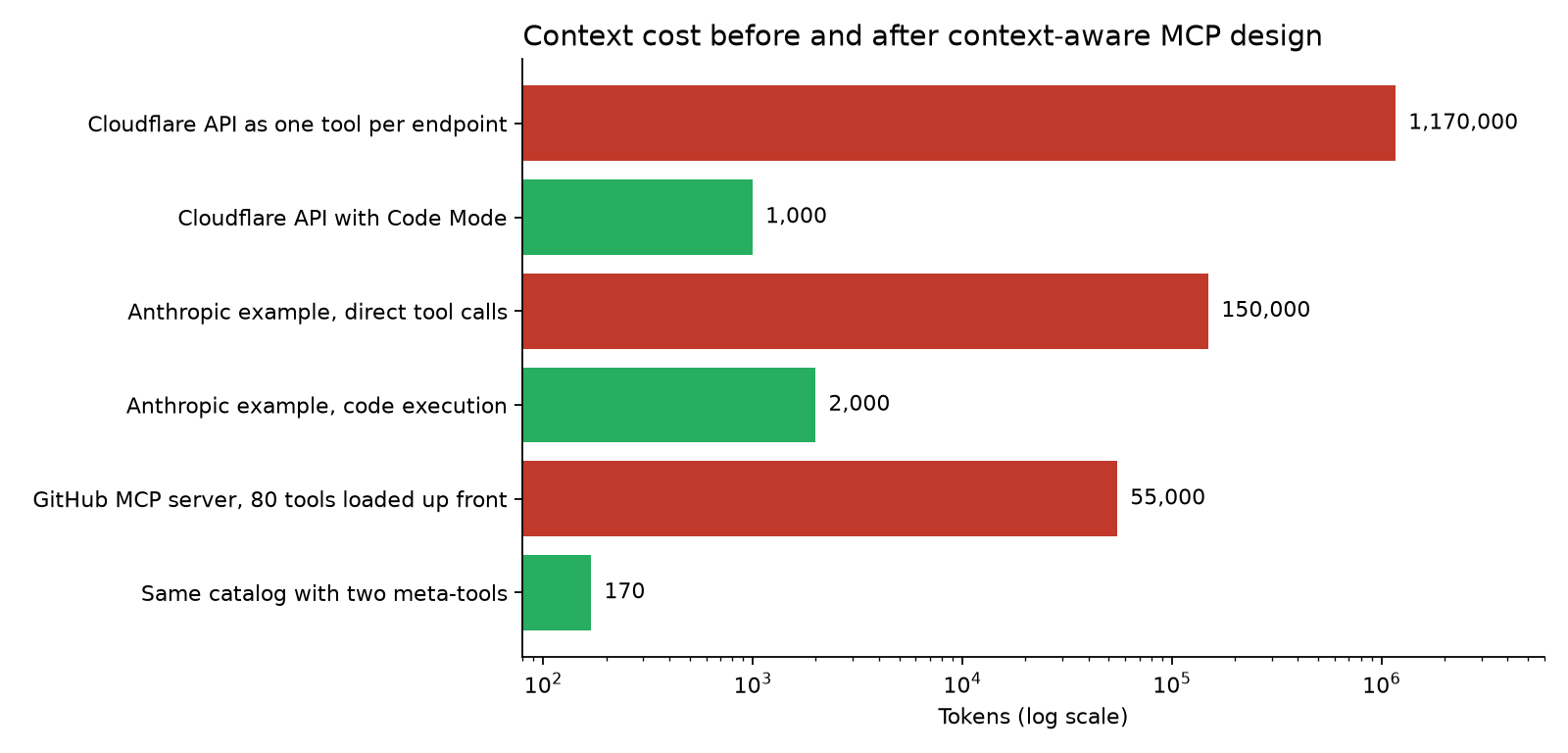
The chart compares figures from different sources under different conditions and illustrates magnitude only. Cloudflare reports about 1.17 million tokens as one tool per endpoint versus about 1,000 with Code Mode (Cloudflare); Anthropic reports 150,000 reduced to 2,000 (Anthropic Engineering); and the Microsoft paper reports about 170 tokens for two progressive-disclosure meta-tools versus about 55,000 for a naive catalog (Malik et al.).
Some techniques already exist in frameworks: FastMCP provides search transforms and an experimental Code Mode transform (FastMCP search transforms, FastMCP transforms). What is missing is a framework that makes these techniques the default rather than opt-in extras, enforces budgets before release, and shows developers how much their server costs an agent, which tool is responsible, and whether a change made agents slower or less accurate. Protocol-level progressive discovery also has no specification proposal yet (One).
2.3 Correctness and safety are also under-served
Basic registration, composition, and multi-server clients are well covered (FastMCP providers, mcp-use server). Harder problems remain largely left to each developer: safe retries of writes, verified authorization, tenant-isolated caching, and task-level evaluation. These are covered in sections 8.2 and 10.
3. Goals and non-goals
3.1 Goals
| ID | Goal | Measured by |
|---|---|---|
| G1 | Developers build a working, lean MCP server in under five minutes | Time from install to first passing local server (DX-8) |
| G2 | Servers built with ouncemcp use far fewer tokens than naive equivalents without lowering task success |
Benchmark suite (section 13) |
| G3 | Correct, safe behavior is the default path | Release gates (section 14) |
| G4 | Developers understand exactly what the agent saw and why | Trace and context views (section 8.4) |
| G5 | Existing FastMCP servers adopt the framework with small changes | Lines changed in migration pilots |
| G6 | Results are reproducible by anyone | Published methodology and scripts |
| G7 | Developers can optionally measure any MCP server, whichever framework built it | ouncemcp audit report (section 8.6) |
3.2 Non-goals for 1.0
- A new MCP protocol implementation or transport stack.
- A custom OAuth or identity server.
- A hosted gateway, marketplace, or visual builder.
- Automatic conversion of every OpenAPI endpoint into a tool.
- Simultaneous SDKs in every language. A TypeScript port is considered after 1.0.
- A mandatory agent orchestration framework.
- Guarantees of identical behavior across every MCP host.
4. Users
| Persona | Need | Primary entry point |
|---|---|---|
| Backend or cloud engineer exposing internal services | Build a fast, secure server quickly | ouncemcp init and the framework |
| Existing FastMCP server maintainer | Make an existing server leaner with small changes | Migration guide; optional ouncemcp audit to compare before and after |
| Platform or security team | Enforce budgets and policy in CI | ouncemcp check in pipelines |
| Agent or host developer | Connect to many servers without context bloat | Reference client |
| Researcher or evaluator | Compare servers reproducibly | Eval kit and benchmark harness |
The proposed initial audience is backend and cloud engineers who build new MCP servers in Python. Maintainers migrating existing servers are the second audience.
5. Product principles
- Lean by default, measured always. The simplest way to write a tool is also the efficient way, and every claim about speed or size is backed by a reproducible measurement.
- Least information that answers the question. Concise results by default; detail on request.
- Fewer turns beat faster transport. Optimize model round trips before micro-optimizing the wire.
- Safe by default, explicit when risky. Writes, approvals, and credentials require deliberate configuration.
- Nothing hidden. Developers can see exactly what the model received.
- Build on standards. Track the MCP specification and adopt official mechanisms when they arrive.
- Accuracy is the guardrail. No optimization ships if it lowers task success.
6. Protocol baseline
6.1 Target revision
The current specification is 2026-07-28, with a stateless core, per-request capabilities, and no initialization handshake or protocol session (MCP specification, release notes). Compatibility contracts in this project MUST use the dated revision rather than labels such as "MCP 2.0."
| Area | Verified baseline | Implication for this project |
|---|---|---|
| Request lifecycle | Modern requests are self-contained; servers must implement server/discover (versioning) |
No hidden connection state for domain data |
| Compatibility | Legacy revisions through 2025-11-25 use initialization; modern-only and legacy-only peers cannot interoperate (versioning) |
Legacy support stays in the adapter and is tested |
| Local transport | Stdio uses newline-delimited JSON-RPC with protocol-only stdout (stdio) | Supported; logs go to stderr |
| Remote transport | Streamable HTTP with required headers mirrored against the body (HTTP transport) | Delegated to the maintained SDK |
| Mid-call input | MRTR returns input requests and resumes through a new request (MRTR) | Continuations must be replay-safe |
| Caching | List and read results carry ttlMs and cacheScope; private results cannot cross authorization contexts (caching) |
Cache keys include authorization context |
| Tool errors | Execution errors use isError: true; protocol errors use JSON-RPC errors (tools) |
Error mapping is part of the runtime |
| Deprecations | Roots, Sampling, and Logging are deprecated; legacy HTTP+SSE is deprecated (release notes) | New features MUST NOT depend on them |
6.2 Foundation choice
FastMCP 4 runs on the MCP Python SDK v2, negotiates modern and legacy protocol eras per connection, and supports interactive input, caching hints, and optional tasks (FastMCP 4 changes). Building on it avoids reimplementing transport and composition. The project MUST pin exact FastMCP and SDK versions and recheck them each release.
7. System overview
                    ┌──────────────────────────────────────────┐
                    │               ouncemcp CLI                │
                    │ init · dev · check · context              │
                    │ eval · bench · trace · audit (optional)   │
                    └────────────────────┬─────────────────────┘
                                         │
                                         ▼
               ┌──────────────────────────────────────────────────┐
               │                 Framework core                    │
               │ capabilities · budgets · discovery modes ·        │
               │ response shaping · errors · policy · execution    │
               │ token accounting (shared by check, dev, audit)    │
               └───────┬───────────────────┬──────────────────────┘
                       │                   │
                       ▼                   ▼
             ┌─────────────────┐   ┌──────────────┐  ┌────────────┐  ┌─────────────────┐
             │ FastMCP 4 /     │   │ Client broker│  │ Eval kit   │  │ Trace & context │
             │ MCP Python SDK  │   │              │  │            │  │ viewer          │
             └─────────────────┘   └──────────────┘  └────────────┘  └─────────────────┘
| Component | Package (proposed) | Role |
|---|---|---|
| Framework core | ouncemcp |
The product: build and run servers |
Developer CLI (init, dev, check, context) |
ouncemcp |
Build-time feedback for framework users |
| Client broker | ouncemcp[client] |
Connect agents to many servers efficiently |
| Eval kit and benchmark | ouncemcp[eval] |
Prove behavior and efficiency |
| Trace viewer | ouncemcp[ui] |
Inspect what the model saw |
| Audit command (optional) | ouncemcp CLI |
Measure any server, including ones not built with ouncemcp |
The framework core is the center of the design. The client, eval kit, and audit command also work with servers built elsewhere, which makes migration and comparison easy, but they exist to support the framework rather than replace it.
7.1 Request pipeline (framework server)
Transport request (FastMCP adapter)
  -> request size and nesting limits
  -> verified identity and request context
  -> capability visibility filter (authorization-scoped catalog)
  -> capability lookup and call authorization
  -> policy: approval, idempotency, effect checks
  -> bounded handler execution (deadline, cancellation)
  -> output validation
  -> response shaping (budget, fields, truncation, handles)
  -> safe result and error mapping
  -> transport response
       └─ redacted trace, token accounting, security event log
8. Functional requirements
8.1 Framework core
8.1.1 Capability definition
| ID | Requirement | Priority | Acceptance criteria |
|---|---|---|---|
| CAP-1 | MUST define tools with typed inputs and outputs (Pydantic), description, handler, effect, and policy | P0 | Example in section 11 runs |
| CAP-2 | MUST support resources and prompts as separate primitives, as defined by MCP (MCP specification) | P1 | Resource and prompt examples pass conformance. Done in M2 (branch claude/loving-shannon-gm4zxr, proposal 0014): server.resource and server.prompt with budgets and policies; conformance fixtures |
| CAP-3 | MUST declare an effect: read, write, or destructive |
P0 | Missing effect fails registration |
| CAP-4 | MUST enforce tool naming rules: 1–128 characters, ASCII letters, digits, underscore, hyphen, and dot (tools) | P0 | Invalid names rejected at startup |
| CAP-5 | MUST lint descriptions for purpose, when-not-to-use guidance, and side effects on writes | P1 | Linter rules with fixtures. Done in M2 (proposal 0017): description-too-short, write-without-side-effects, missing-usage-guidance |
| CAP-6 | MUST NOT expose tenant identity, credentials, or approval state as model-controlled parameters | P0 | Registration rejects reserved parameter names; documented |
| CAP-7 | SHOULD support composite workflow tools that combine several service calls | P0 | Example composite tool with tests. Done in M1 (branch claude/loving-shannon-gm4zxr, not yet merged): ctx.gather runs steps concurrently inside the deadline; examples/inventory/workflow.py (inventory.cost_review) returns 651 tokens in 1 call where paging inventory.search takes 9,896 tokens over 8 calls |
8.1.2 Context budgets
Budgets are declared per server and per tool. The defaults below are proposed starting points derived from the evidence above and must be validated in the benchmark phase.
| Budget | Proposed default | Rationale |
|---|---|---|
| Per-tool definition | Target 250, warn 500, fail 1,000 tokens | Median around 100 and heavy tools near 1,000 in measured servers (MCP discussion #2812) |
| Server startup definitions | Warn 4,000; switch to discovery above the threshold in 8.1.3 | Guidance suggests switching at about 1–5% of the context window (MCP client best practices) |
| Default result | 2,000 tokens | Keeps typical results small; detail available on request |
| Hard result ceiling | 8,000 tokens | Below the 25,000-token default limit Anthropic reports for Claude Code (Anthropic tool guidance) |
| ID | Requirement | Priority | Acceptance criteria |
|---|---|---|---|
| BUD-1 | MUST compute definition token counts at startup and in ouncemcp check, measured on definitions as an MCP client receives them (wire serialization and field order), not on in-process objects |
P0 | Counts appear in check output and equal a recount of tools/list over stdio (done in M0) |
| BUD-2 | MUST fail check when a fail threshold is exceeded |
P0 | CI exit code tests |
| BUD-3 | MUST enforce result budgets at runtime through response shaping (8.1.4) | P0 | Oversized results never exceed hard ceiling |
| BUD-4 | MUST allow overrides per tool with a recorded justification | P1 | Override without reason produces a warning. Done in M4 (proposal 0021): definition_tokens= and budget_reason= on tools, BudgetOverrideWarning, the budget-override-without-reason lint, overrides listed by check |
| BUD-5 | SHOULD record actual token usage per call in traces | P0 | Trace includes result tokens. Done in M1 (branch claude/loving-shannon-gm4zxr, not yet merged, proposal 0009): OunceServer(trace=...) records result tokens, budget, truncation, latency, attempts and outcome per call |
| BUD-6 | MUST make the tokenizer pluggable: any tiktoken encoding, a custom counting callable, and provider token-counting APIs; every report MUST name the tokenizer used | P0 (interface and tiktoken), P1 (provider APIs) | Same server reported with two tokenizers; reports show the tokenizer name; provider adapter tested against a recorded response. Interface, tiktoken encodings and custom callables done in M1 (PR #8, merged): get_counter and OunceServer(tokenizer=, tokenizer_name=) take an encoding, a TokenCounter or a named function; check, context, ServerCost, results and too-large errors name the tokenizer. Provider APIs done for 1.0: AnthropicCounter and --tokenizer anthropic:MODEL use Anthropic's counting API through the official SDK, tested against a recorded response; OpenAI models count exactly with tiktoken, and other providers plug in a counting function |
| BUD-7 | MUST state which definition fields are counted (name, description, input schema, output schema) and which are not (title, annotations, _meta); SHOULD record per host which fields reach the model |
P0 (declared scope), P1 (per-host data) | check --json includes the counting scope; host findings published in the compatibility matrix. Declared scope done in M1 (PR #9, merged): counting_scope in check --json, Counted and Not counted lines in check and context, and verified_hosts: [] until the host study. Per-host data (P1) remains |
| BUD-8 | MUST compact advertised schemas without changing what validation accepts: collapse optional anyOf with null, drop generated titles |
P0 | Property test: every fixture input accepted by the Pydantic model is valid against the advertised schema and the reverse, apart from explicit null for optional fields, which the model still accepts |
| BUD-9 | MUST let servers and tools choose output schemas on, off, or auto, and check MUST report the output-schema share of definition tokens |
P0 | Three modes tested; check shows the share (M0 inventory: 241 of 488 tokens). Done in M1 (PR #9, merged): output_schemas= on the server and output_schema= on a tool take on (default), off or auto; auto drops a schema only when it would put a definition over Budget.tool_definition_target; check reports output_schema_tokens, output_schema_share and per-tool fields (inventory: 241 of 488) |
8.1.3 Automatic discovery mode
| Mode | When selected (proposed) | Exposed to the model |
|---|---|---|
direct |
Startup definitions within budget | All visible tools |
search |
Startup definitions exceed budget | Pinned tools plus search_tools, describe_tool, and call_tool meta-tools |
code (opt-in) |
Very large APIs where developers explicitly enable it | search and execute in a sandbox, as in Cloudflare Code Mode (Cloudflare) |
| ID | Requirement | Priority | Acceptance criteria |
|---|---|---|---|
| DISC-1 | MUST select direct or search automatically from measured cost, with explicit override |
P0 | Mode switches at configured threshold. Done in M1 (PR #10): auto compares measured direct tokens with Budget.startup_tokens and picks search only if it is smaller |
| DISC-2 | MUST apply authorization before search results are returned | P0 | Unauthorized tools never appear in search. Done in M1 (PR #10): search and describe_tool read FastMCP's auth-filtered catalog; tested at all three detail levels |
| DISC-3 | MUST keep hidden tools callable only when authorized; hiding is not access control | P0 | Guessed-name call by unauthorized principal fails. Done in M1 (PR #10): same auth check on direct and call_tool calls; unknown and unauthorized names get the same answer |
| DISC-4 | MUST offer name-only, summary, and full-schema detail levels, as recommended (MCP client best practices) | P0 | Three levels tested. Done in M1 (PR #10): name, summary, full on search_tools and describe_tool |
| DISC-5 | MUST keep meta-tool definitions stable to protect prompt caches (MCP client best practices) | P0 | Definitions byte-identical across catalog changes. Done in M1 (PR #10): built once, order fixed, tested across catalogs and pinned sets |
| DISC-6 | MUST measure search recall in the eval kit so reduced tokens do not hide needed tools | P0 | Recall reported in eval output. Done: server.measure_recall(cases) (PR #10); suites with a recall section report it in ouncemcp eval output (proposal 0019) |
| DISC-7 | SHOULD build on FastMCP search transforms rather than reimplementing them | P0 | Implementation review. Done in M1 (PR #10): OunceSearchTransform subclasses FastMCP's BM25SearchTransform |
| DISC-8 | code mode MUST run generated code with no direct network or credential access and authorize every brokered call (MCP client best practices) |
P2 | Security test suite for sandbox escape and unauthorized calls |
8.1.4 Response shaping
| ID | Requirement | Priority | Acceptance criteria |
|---|---|---|---|
| RES-1 | MUST support concise (default) and detailed response formats, following Anthropic's guidance (Anthropic tool guidance) |
P0 | Both formats tested per example tool |
| RES-2 | MUST support field selection and server-side filtering declared in the output model | P0 | Unrequested fields absent |
| RES-3 | MUST paginate lists with bounded page sizes and stable cursors; a returned cursor MUST resume immediately after the last item actually returned. Cursors are opaque and an empty string is a valid cursor, following the MCP pagination rules (pagination) | P0 | Pagination tests, plus the RES-9 property test |
| RES-4 | MUST truncate over-budget results with a clear note of what was omitted and how to retrieve more; the note's measured size MUST be reserved from the budget (version 0.4 replaces the fixed 80-token reserve), the full note names at most three paths, a short note is used when the full note would exceed 10% of the budget, and every note ends with one recovery action | P0 | Truncation note present and accurate; result plus note within budget. Done in M1 (PR #4) |
| RES-5 | SHOULD return large results by reference: a summary plus an opaque handle readable in pages | P1 | Handle bound to principal and expiry. Done in M2 (proposal 0013): ctx.store_result, handles.read, ctx.start_job, jobs.get, bound to caller and tenant |
| RES-6 | MUST strip transport metadata and auxiliary upstream fields not declared in the output model, given evidence that raw JSON inflates tokens (Anjum et al.) | P0 | Output equals declared model |
| RES-7 | MUST return both structured content and a compact text rendering when an output schema exists (tools) | P0 | Conformance passes |
| RES-8 | When an output schema is advertised, every successful result MUST include structured content that conforms to it, since MCP requires this of servers (tools). Shaping MUST degrade in this order: trim lists (RES-10), shorten strings, drop optional fields. If the result still exceeds the budget, it MUST return a tool error (isError: true) with a short, actionable message such as asking for a smaller limit, rather than unstructured text. Text-only truncation is allowed only for tools without an output schema |
P0 | Fuzz test over random outputs and budgets: every successful result validates against the advertised schema; over-budget minimal results return isError with a recovery hint. Done in M1 (PR #3): every change is checked against the advertised schema; errors carry reason (item_over_budget, min_items_over_budget, fixed_over_budget) and suggest a lower limit only when it can help (PR #4) |
| RES-9 | MUST provide budget-aware pagination: a ctx.page(rows, cursor=..., limit=...) helper (settled in proposal 0002, with Paginated and Cursor field markers) that keeps as many items as fit the remaining result budget and builds the cursor from the last kept item. When the framework trims a list that a handler paginated itself, it MUST warn in the note that the cursor skips the removed items and give a limit that pages without gaps |
P0 | Property test: for any data set, page size, and budget, following cursors returns every item exactly once. Done in M1 (PR #3) |
| RES-10 | MUST NOT trim a non-empty list to zero items; the minimum is configurable per tool (default 1), and an oversized single item is shortened instead of dropped | P0 | Test with one item larger than the budget (fixed in M0); min_items per tool, default 1, values below 1 rejected. Done in M1 (PR #3) |
| RES-11 | SHOULD let handlers skip expensive work for fields that will not be returned, by exposing the response format and remaining budget on the context | P1 | Example tool that skips a detail lookup in concise mode. Done in M4: ctx.includes(path) and ctx.detailed alongside ctx.response_format and ctx.result_budget; inventory.get fetches metrics only for detailed calls |
8.1.5 Errors and execution
| ID | Requirement | Priority | Acceptance criteria |
|---|---|---|---|
| ERR-1 | MUST map errors into categories: validation, authentication, permission, not found, rate limit, transient, ambiguous write, internal | P0 | Each category has a test. Done in M1 (PR #11): core/errors.py; 24 cases cover all eight categories, with a retryable flag |
| ERR-2 | MUST return actionable, short validation messages that state how to correct the input | P0 | Messages under a configured length. Done in M1 (PR #11): fix-it messages that never repeat the values sent, capped by Limits.max_error_chars |
| ERR-3 | MUST NOT expose stack traces, secrets, or internal hostnames | P0 | Redaction tests. Done in M1 (PR #11): unexpected exceptions return a reference id and no text; author messages pass through redact() |
| EXE-1 | MUST enforce a deadline on every call and propagate cancellation to upstream calls (cancellation) | P0 | Timeout tests. Done in M1 (PR #11): default 30 s deadline on every call; cancellation reaches the handler; ctx.remaining() |
| EXE-2 | MUST retry only transient read failures, with bounded backoff inside the deadline | P0 | No automatic write retries. Done in M1 (PR #11): RetryPolicy, reads only, shares the call's deadline |
| EXE-3 | MUST report ambiguous status for write timeouts unless idempotency resolves them | P0 | Fault-injection test. Done in M1 (PR #11): ambiguous_write on write timeouts; write_resolver seam, with no idempotency store yet |
| EXE-4 | MUST provide an idempotency mechanism for writes, keyed by principal, tenant, operation, and normalized argument digest | P1 | Duplicate replay produces one effect. Not started; the write_resolver seam in PR #11 is where it plugs in. Done in M2 (proposal 0011): idempotency=True, keyed by principal, tenant, tool and argument digest or a client key; shared store; a timed-out write finishes and is replayed |
| EXE-5 | MUST mark read-only, independent tools as parallel-safe for clients | P1 | Metadata present. Done in M4 (proposal 0022): _meta["ouncemcp/parallelSafe"] on every tool, true for reads unless parallel_safe=False, never for writes; is_parallel_safe() for clients |
| EXE-6 | MUST bound request size, nesting depth, output size, and concurrency per principal | P0 | Limit tests. Done in M1 (PR #11): Limits for request bytes, nesting depth and per-principal concurrency; output is bounded by the result ceiling |
8.2 Security and policy
| ID | Requirement | Priority | Acceptance criteria |
|---|---|---|---|
| SEC-1 | MUST derive identity from verified credentials only; self-reported client identity MUST NOT drive decisions (base protocol) | P0 | Spoofed clientInfo has no effect. Done in M1: ctx.identity from the verified token only; principal combines issuer and subject; tested with a spoofed clientInfo |
| SEC-2 | MUST enforce policy on both catalog visibility and direct calls | P0 | See DISC-3. Done in M1: policy= on server and tools becomes one auth check for lists, search and calls. Over stdio FastMCP skips component auth (see 15.3, open decisions) |
| SEC-3 | MUST treat tool annotations as hints, not enforcement (MCP specification) | P0 | Policy engine ignores annotations for access decisions. Done in M1: policies get the declared effect; tested by relabelling a destructive tool read-only |
| SEC-4 | MUST validate token audience and MUST NOT pass inbound MCP tokens to upstream APIs (authorization security) | P0 | Passthrough attempt rejected in tests. Done in M1: audience= checks aud and resource; check_outbound and passthrough_guard() refuse the inbound token |
| SEC-5 | MUST partition private caches by authorization context (caching) | P0 | Cross-tenant cache test. Done in M1: ctx.cache, keyed by principal, tenant and scopes |
| SEC-6 | MUST bind handles, approvals, and request state to principal, expiry, and originating request (MRTR) | P0 | Replay and cross-principal tests. Done in M1: ctx.issue_state and ctx.verify_state(consume=...), signed b1. tokens; single use is per process until a shared store (EXE-4) |
| SEC-7 | MUST NOT perform irreversible effects before an input-required return unless replay-safe | P0 | Lint rule plus test. Done in M1: ctx.require_input refuses after ctx.effect_applied() unless replay_safe; check rule input-after-effect |
| SEC-8 | MUST validate Origin on HTTP and bind local HTTP servers to loopback by default (HTTP transport) |
P0 | Delegated to SDK; verified in tests. Done in M1: HTTP binds 127.0.0.1 with Host and Origin checks on; public binds need allowed_hosts |
| SEC-9 | MUST protect outbound fetches from SSRF using allowlists and private-range blocking (security best practices) | P1 | SSRF test suite. Done: check_url in M2 (proposal 0015); in M4, safe_client pins each connection to the checked address, checks every redirect and keeps one pool per host name (proposal 0023) |
| SEC-10 | SHOULD use maintained OAuth integrations; client registration order is pre-registration, then Client ID Metadata Documents, then deprecated Dynamic Client Registration (client registration) | P1 | Integration tests with one provider. Done in M4 (proposal 0025): servers use FastMCP's maintained providers via OunceServer(auth=...); clients use OunceOAuth, which applies the registration order and records it; audit --oauth and Broker(auth=...); full flows tested over HTTP against FastMCP's in-memory OAuth provider |
| SEC-11 | MUST redact secrets and personal data from traces by default | P0 | Redaction tests. Done in M1 (proposal 0009): hashed principals, no messages or results, arguments only on request and redacted |
| SEC-12 | MUST issue tamper-evident cursors: HMAC-signed and bound to the principal, the tool, a digest of the normalized query arguments, and an expiry; support key rotation; reject invalid, expired, or foreign cursors with an actionable validation error (MCP suggests -32602 Invalid params for invalid list cursors, pagination) |
P0 | Tests for tampering, expiry, cross-principal reuse, use with changed filters, and rotation; the M0 base64 offset cursor is removed. Done in M1 (PR #7, merged): s1. cursors of 59 characters, bound to tool, principal and arguments other than cursor, limit and response_format; one-hour expiry by default; keys from CursorSigner or OUNCEMCP_CURSOR_KEYS, newest first; a random per-process key with a one-time warning when none is set; errors carry a reason (malformed, legacy, signature, expired, tool, principal, query) |
8.3 Client broker
| ID | Requirement | Priority | Acceptance criteria |
|---|---|---|---|
| CLI-1 | MUST connect to multiple configured servers with stable local IDs and namespaced tool names, since server names are not guaranteed unique (tools) | P1 | Collision tests. Done in M2 (proposal 0016) |
| CLI-2 | MUST provide progressive discovery across servers when total definitions exceed budget | P1 | Same rules as DISC. Done in M2 (proposal 0016) |
| CLI-3 | MUST cache definitions host-side, honor ttlMs and cacheScope, and invalidate on list_changed (MCP client best practices) |
P1 | Cache tests. Done in M2 (proposal 0016) |
| CLI-4 | MUST validate structured outputs against declared schemas | P1 | Invalid output surfaces an error. Done in M2 (proposal 0016) |
| CLI-5 | MUST expose approval and elicitation hooks and refuse unsupported sensitive flows | P1 | Hook tests. Done in M2 (proposal 0016) |
| CLI-6 | MUST enforce total deadlines, reuse connections, and isolate failing servers | P1 | Fault-injection tests. Done in M2 (proposal 0016) |
| CLI-7 | MUST report every result's token count to the host | P1 | API returns token metadata. Done in M2 (proposal 0016) |
| CLI-8 | MUST NOT treat server descriptions, instructions, or results as authority to call another server (MCP client best practices) | P1 | Prompt-injection test cases. Done in M2 (proposal 0016) |
8.4 Developer experience
| ID | Requirement | Priority | Acceptance criteria |
|---|---|---|---|
| DX-1 | ouncemcp init MUST scaffold a working server with one read tool, one write tool, tests, and CI config |
P0 | Scaffold passes its own tests. Done in M1 (branch claude/loving-shannon-gm4zxr, not yet merged): the generated project's 6 tests run in the suite |
| DX-2 | ouncemcp dev MUST run with hot reload and print a live budget summary |
P0 | Manual and automated checks. Done in M1 (branch claude/loving-shannon-gm4zxr, not yet merged): restarts on .py/.toml changes, prints the summary and one line per call; end-to-end test over HTTP |
| DX-3 | ouncemcp check MUST run schema, naming, description, budget, and policy lints |
P0 | Rule catalog documented. Done: budgets; naming (CAP-4 at registration, inconsistent-tool-names); schema (undocumented-parameter, free-form-input, unpaginated-list); descriptions (CAP-5); budget overrides (BUD-4); policy and safety (input-after-effect, elicit-in-write, destructive-without-policy, stdio-skips-policy). Every rule has a page in docs/rules/, and the examples and the init scaffold are lint-clean (tested) |
| DX-4 | A context view MUST show exactly what the model received for each definition and result, with token counts | P0 (terminal), P1 (web) | Matches serialized payload. Done: terminal context and context --call (proposal 0018); context --html page with every definition as received, its token breakdown and call results (proposal 0024) |
| DX-5 | A trace view MUST show latency, retries, errors, truncation decisions, and policy outcomes per call | P1 | Trace export as OpenTelemetry. Done: OTelSink and ouncemcp trace HTML report (proposal 0018) |
| DX-6 | Every lint and error MUST link to a documentation page explaining cause and fix | P0 | Link check in CI. Done in M1: _meta.ouncemcp.docs on errors, a page per category and rule, and tests/test_dx6_doc_links.py checks pages, codes and relative links |
| DX-7 | A migration guide MUST convert an existing FastMCP server in small steps | P0 | Pilot migrations (section 15). Done in M2 (proposal 0015): OunceServer.wrap and docs/guides/migrating-from-fastmcp.md, worked on markitdown-mcp |
| DX-8 | Time from install to first passing local server MUST be under 5 minutes in user testing | P0 | Measured with at least five testers |
8.5 Evaluation kit
| ID | Requirement | Priority | Acceptance criteria |
|---|---|---|---|
| EVAL-1 | MUST run the official conformance suite for declared revisions (conformance) | P0 | CI job. Done: ouncemcp.eval.conformance target and .github/workflows/conformance.yml (suite 0.2.0-alpha.12, revision 2026-07-28); baseline confirmed by CI (36 passed, 5 expected failures) and the job gates since M4 (no continue-on-error) |
| EVAL-2 | MUST provide security tests: cross-tenant access, guessed names and handles, replay, SSRF, token passthrough | P0 | Test catalog. Done in M1: ouncemcp.eval.security with six probe types and automatic guessed-name probes |
| EVAL-3 | MUST run agent task suites defined in YAML with verifiable outcomes | P1 | Example suite per pilot. Done: replay model (proposal 0019) and real models through OpenRouter with a spending cap (proposal 0026); suites for the inventory and ticketing pilots, both run against a real model |
| EVAL-4 | MUST report task success, correct tool selection, argument validity, calls per task, turns, tokens, latency, and errors, as Anthropic recommends measuring (Anthropic tool guidance) | P1 | Report fields. Done (proposal 0019) |
| EVAL-5 | MUST record model, host, tokenizer, server version, and environment with every result | P1 | Report header. Done |
| EVAL-6 | MUST support held-out tasks to detect overfitting of descriptions | P1 | Split configuration. Done: split: heldout and the train minus held-out gap |
| EVAL-7 | MUST compare two configurations and flag regressions in success or efficiency | P1 | Compare command. Done: eval --compare old.json --fail-on-regression |
8.6 Optional audit command (ouncemcp audit)
The audit command is an optional feature of the CLI. It is never required to build, run, or ship a server with the framework. It reuses the same token-accounting engine as check, dev, and context, but connects over MCP as a client, so it can measure servers built with ouncemcp, plain FastMCP, or any other framework. Typical uses are checking a deployed server, comparing a server before and after migration, and collecting benchmark data. It ships in v0.2 (milestone M2).
| ID | Requirement | Priority | Acceptance criteria |
|---|---|---|---|
| AUD-1 | MUST connect to stdio servers by command and remote servers by URL, with bearer token or OAuth | P1 | Audits a stdio server and an authenticated HTTP server in tests. Done in M2 (proposal 0015) |
| AUD-2 | MUST negotiate modern and legacy protocol eras | P1 | Audits a 2026-07-28 server and a 2025-11-25 server. Done in M2 (proposal 0015) |
| AUD-3 | MUST report startup definition cost: total tokens, tool count, and per-tool tokens for tools, resources, and prompts | P1 | Totals match an independent recount within 1% for the same tokenizer. Done in M2 (proposal 0015) |
| AUD-4 | MUST break down each tool's cost into description, input schema, and output schema | P1 | Breakdown sums to tool total. Done in M2 (proposal 0015) |
| AUD-5 | MUST flag schema bloat: long descriptions, deep nesting, large enums, duplicated text, unused optional fields | P1 | Each rule has a fixture that triggers it. Done in M2 (proposal 0015) |
| AUD-6 | MUST state the tokenizer used; default is a documented open tokenizer, with optional provider token-count APIs | P1 | Report header names tokenizer and version. Done in M2 (proposal 0015) |
| AUD-7 | SHOULD sample responses from read-only tools using user-supplied or generated safe arguments, reporting median and p95 result tokens | P2 | Runs only tools the user marks safe or annotated read-only, and asks before calling. Done in M2 (proposal 0015) |
| AUD-8 | SHOULD measure discovery and call latency (p50, p95) and connection failures | P2 | Latency reported with environment details. Done in M2: connect time and tools/list p50/p95; connection failures reported |
| AUD-9 | MUST recommend a discovery mode and estimate its startup cost | P1 | Recommendation follows rules in section 8.1.3. Done in M2 (proposal 0015) |
| AUD-10 | MUST output terminal summary, JSON, Markdown, and HTML reports | P1 (JSON, terminal), P2 (HTML) | JSON validates against a published schema. Done: terminal, JSON and Markdown in M2; HTML (audit --html) in M4 (proposal 0024) |
| AUD-11 | MUST support --budget thresholds and non-zero exit on failure for CI |
P1 | Exit code tests. Done in M2 (proposal 0015) |
| AUD-12 | MUST never call tools without explicit permission except discovery methods | P1 | Default run makes only list and discover calls. Done in M2 (proposal 0015) |
| AUD-13 | SHOULD compare two reports and show regressions | P2 | ouncemcp audit --compare old.json. Done in M2: --compare, --fail-on-regression |
Illustrative output (format proposed; values are examples):
$ uvx ouncemcp audit https://example.com/mcp

Server            example-server (protocol 2026-07-28)
Tokenizer         o200k_base
Startup context   44,026 tokens · 43 tools          FAIL  budget 4,000
Largest tools     create_issue 1,380 · update_pr 1,210 · search_code 1,050
Bloat findings    12 long descriptions · 5 nested schemas · 3 large enums
Median result     3,100 tokens (5 sampled tools)    WARN  budget 2,000
Recommendation    progressive discovery              est. startup 180 tokens
Report            ./ouncemcp-report.html
Measurement method. Definition cost is measured on the compact JSON serialization of each tool's name, description, inputSchema, and (optionally) outputSchema. Hosts present definitions differently, so reports MUST state that figures are a consistent estimate rather than an exact host cost. Discussion of measured servers shows a median of about 103 tokens per tool and heavy tools around 1,000 (MCP discussion #2812), which gives initial calibration targets.
9. Non-functional requirements
9.1 Performance
Protocol overhead is small, so performance targets focus on tokens and turns first. Framework overhead targets are proposed and must be measured on a documented machine.
| ID | Requirement | Target (proposed) |
|---|---|---|
| PERF-1 | Framework middleware overhead per call, excluding handler | p50 under 2 ms, p95 under 10 ms. Met in M4: 0.24 to 0.43 ms p50 added (report) |
| PERF-2 | Server cold start for 50 tools, compared with plain FastMCP | At most 0.75 s added over a plain FastMCP server with the same 50 tools (revised in M4; was "under 1 second" in total, which FastMCP alone takes on a 4-vCPU machine). Met: 0.57 s added (1.60 s against 1.03 s), M4 report |
| PERF-3 | Token counting at startup for 500 tools | Under 2 seconds. Met in M4: 0.30 s |
| PERF-4 | Optional audit of a 100-tool server, discovery only | Under 10 seconds on a normal network. Met in M4: 0.28 s on loopback |
| PERF-5 | Startup context in search mode |
Under 400 tokens. Met in M4: 279 tokens for 100 tools |
| PERF-6 | Benchmark target versus naive equivalent | Revised in M3 (proposal 0027, accepted). Large servers (plain definitions over the 4,000-token startup budget): at least 70% fewer startup tokens, fewer total task tokens, no drop in task success. Small servers: definitions at most 2× the plain server's and no drop in task success; fewer task tokens is required when results average over 500 tokens per task. First benchmark: met for 4 of 8 pairs (ticketing, all models); inventory definitions are 2.4× plain (584 vs 244 tokens), over the limit, while its task tokens fell 58–85%; large servers not benchmarked yet |
| PERF-7 | Added overhead when a 50-item result is truncated | p50 under 1 ms (M0 measured 1.44 ms). Met in M1: 0.70 ms p50, 0.80 ms p95 |
M0 measured PERF-1 at +0.14 to +0.44 ms p50 for untruncated results and +1.44 ms p50 when truncating, on Python 3.12, x86_64, 2 vCPUs (M0 report).
After the M1 changes (PR #4), on the same machine, untruncated calls add 0.14 to 0.31 ms p50 and truncated 50-item calls add 0.70 ms p50. Shaping alone takes 0.70 ms for 50 items at a 300-token budget, 3.1 ms for 100 items at 2,000 tokens, and 7.3 ms for a 36,000-token result at 2,000 tokens. Before PR #4 these were 2.2, 9.9 and 37.6 ms. Shaping cost now grows with the budget, not the result size. For very large results, the remaining cost is converting the whole model to JSON.
PERF-6 is a hypothesis informed by reported progressive-disclosure reductions of 71–99% (Malik et al.); it must not be published as a claim until the benchmark in section 13 confirms it.
9.2 Reliability
- Remote failures must be fast and explicit; the widely cited 28% MCP failure rate in one benchmark came from connection timeouts, not protocol behavior (GAX summary).
- Health endpoint, readiness checks, and documented timeouts are required for remote deployments.
- No process-local state may be required for correctness across replicas; FastMCP's default stores are process-local and need shared backends for multi-replica use (FastMCP 4 changes).
9.3 Compatibility
- Python 3.11 or later; exact supported versions listed per release.
- Declared host compatibility matrix with named versions, tested in CI where automation allows.
- Semantic versioning; breaking changes only in major versions with a migration guide.
9.4 Observability
- OpenTelemetry traces and metrics, with no mandatory backend.
- Metrics per tool: calls, errors by category, latency, result tokens, truncations.
10. Execution semantics
| Failure | Required behavior |
|---|---|
| Invalid arguments | Actionable validation error; no retry of unchanged input |
| Authentication failure | Reauthorize only through the permitted credential flow |
| Permission denial | Fail closed; never suggest broader authority |
| Transient read failure | Bounded retry with backoff inside the deadline |
| Write timeout | Report ambiguous status unless idempotency or reconciliation resolves it |
| Rate limit | Respect upstream retry guidance and remaining deadline |
| Partial workflow failure | Return completed effects and recovery options |
Cancellation is not rollback; the specification acknowledges races between cancellation and completion (cancellation). MRTR continuations run the tool again, and FastMCP documents that interactive tools rerun from the top (FastMCP 4 changes), so approval receipts must bind the exact action and arguments, expire quickly, and be single-use where required (MRTR).
11. Public API sketch
This sketch is proposed and will change during M1. The M0 API that actually ships is recorded in proposal 0001. It shows the intended developer experience, not a published API.
from pydantic import BaseModel, Field
from ouncemcp import OunceServer, Context, Effect, Budget, policy

server = OunceServer(
    name="inventory",
    budget=Budget(startup_tokens=4_000, result_tokens=2_000),
    discovery="auto",          # direct | search | auto
)

class SearchInput(BaseModel):
    region: str = Field(description="Cloud region, e.g. ap-south-1")
    kind: str | None = Field(None, description="Resource type filter")
    limit: int = Field(20, ge=1, le=100)

class Resource(BaseModel):
    id: str
    kind: str
    name: str
    status: str

class SearchResult(BaseModel):
    items: list[Resource]
    next_cursor: str | None = None

@server.tool(
    name="inventory.search",
    effect=Effect.READ,
    policy=policy.requires("inventory.read"),
    deadline_ms=5_000,
)
async def search(args: SearchInput, ctx: Context) -> SearchResult:
    """Find cloud resources the caller may see, filtered by region and type.
    Use inventory.get for full details of one resource."""
    rows = await ctx.deps.inventory.search(
        tenant=ctx.tenant, region=args.region, kind=args.kind, limit=args.limit
    )
    return SearchResult(items=[Resource(**r) for r in rows])

if __name__ == "__main__":
    server.run()   # stdio by default; server.run(http=True) for Streamable HTTP
Configuration file (proposed):
# ouncemcp.toml
[budget]
tool_definition_warn = 500
tool_definition_fail = 1000
startup_warn = 4000
result_default = 2000
result_ceiling = 8000

[discovery]
mode = "auto"
pinned = ["inventory.search"]

[tokenizer]
default = "o200k_base"

[security]
http_bind = "127.0.0.1"
redact = ["authorization", "password", "token"]
12. CLI specification
| Command | Purpose | Priority |
|---|---|---|
ouncemcp init <name> |
Scaffold a server with tests and CI | P0 |
ouncemcp dev |
Run with hot reload and live budget summary | P0 |
ouncemcp check |
Lint schemas, names, descriptions, budgets, policy; CI-friendly exit codes | P0 |
ouncemcp context <tool> |
Show exactly what the model receives for a tool and a sample result | P0 |
ouncemcp eval <suite.yaml> |
Run security and agent task suites | P1 |
ouncemcp bench |
Run the reproducible benchmark harness | P1 |
ouncemcp trace |
Open the trace and context viewer | P1 |
ouncemcp audit <url or command> |
Optional: measure any MCP server over the protocol and recommend fixes | P1 (ships in v0.2) |
Distribution: uvx ouncemcp and pipx install ouncemcp. A thin npx wrapper for the auditor is P2.
13. Benchmark plan
The benchmark proves that servers built with the framework are leaner without losing accuracy. It is also the main evidence for the public launch.
13.1 Design
- Servers: The pilot servers in section 15.1, plus 10–20 popular open-source MCP servers covering developer tools, SaaS, databases, and documentation.
- Conditions: Each capability set built as a plain FastMCP server versus the same capabilities built with
ouncemcp; for open-source servers, as published versus after migration. The optional audit command can collect the startup figures. - Tasks: At least 10 realistic tasks per server with verifiable outcomes, plus held-out tasks.
- Models and hosts: At least two models from different providers and one named host; all recorded.
- Repetitions: At least 5 runs per task and condition to report variance.
13.2 Metrics
| Metric | Definition |
|---|---|
| Startup tokens | Definition tokens before the first user message |
| Task tokens | Total input and output tokens to completion |
| Turns | Model round trips to completion |
| Wall-clock time | End to end, with p50 and p95 |
| Task success | Verified outcome, not model self-report |
| Tool selection accuracy | Correct tool chosen at each step |
| Failure rate | Split into connection, protocol, tool, and model errors |
13.3 Publication rules
- Publish scripts, configurations, raw results, and environment details.
- Report regressions and failures as well as improvements.
- Invite server maintainers to review results before publication.
- Never publish a percentage improvement that is not reproducible from the published scripts.
Independent results can qualify launch claims quickly, as happened with Jev, where independent tests showed weaker results on some single-question tasks than on decomposed ones (Firecrux). Publishing caveats first protects credibility.
14. Testing strategy and release gates
14.1 Test layers
| Layer | Tests | Failure exposed |
|---|---|---|
| Unit and domain | Services without MCP | Business logic errors |
| Contract | Inputs, outputs, errors, schema snapshots | Drift |
| Budget | Token counts against thresholds; snapshot of definitions | Context regressions |
| Protocol | Official conformance suite (conformance) | Wire incompatibility |
| Transport | Real stdio subprocess and real HTTP endpoint | Lifecycle defects |
| Security | Tenant isolation, guessed names and handles, replay, SSRF, passthrough | Bypass and exfiltration |
| Resilience | Timeouts, disconnects, rate limits, restarts, partial writes | Duplicate effects |
| Agent | Task suites with held-out cases | Poor selection or unusable contracts |
| Performance | PERF targets on a documented machine | Overhead regressions |
FastMCP supports in-process testing through its client with pytest (FastMCP testing); transport tests must additionally use real processes and network endpoints.
14.2 Release gates
A release MUST NOT ship if any gate fails:
- Conformance: All declared revision and transport pairs pass.
- Isolation: No cross-tenant access to catalogs, caches, handles, approvals, or jobs.
- Writes: No duplicate effects on replay within the documented guarantee.
- Approvals: Unsupported clients cannot bypass required approvals.
- Budgets: Example servers and scaffold pass
ouncemcp check, and the shaping fuzz test (RES-8) and pagination property test (RES-9) pass. - Accuracy: No statistically meaningful drop in task success versus the previous release. Check in place (M4):
ouncemcp bench --compare benchmarks/results/m3-bench.json --fail-on-regression, a one-sided Fisher exact test per suite, model and server (M4 report). - Performance: PERF-1 through PERF-5 met or regressions explained.
- Documentation: Every lint rule and error links to a working page.
15. Roadmap and milestones
Durations are planning estimates for a small team (about 26 weeks to 1.0) and should be revised after M0. Each milestone produces something usable on its own.
| Milestone | Scope | Exit criteria | Estimate |
|---|---|---|---|
| M0: Core spike | OunceServer and tool decorator over FastMCP; typed inputs and outputs with declared effects; definition token counting; result budgets with concise and detailed formats and truncation; one read-only example server |
Example server works in one named host; token counts match a manual recount; framework overhead measured against PERF-1. Status: done, except host verification, which was verified over a real stdio client only and moves to M1 (M0 report) | 2 weeks |
| M1: Framework 0.1 (first public release) | P0 requirements for CAP, BUD, DISC (direct and search with automatic switching), RES, ERR, EXE (except idempotency), and SEC; M0 carry-over first: RES-8 to RES-10, SEC-12, BUD-6 to BUD-9, PERF-7 (section 15.2). Status: in progress. RES-8 to RES-10, PERF-7 and SEC-12 done; BUD-6 done; BUD-7 (declared scope) and BUD-9 done; DISC-1 to DISC-5 and DISC-7 done (DISC-6 partly); ERR-1 to ERR-3, EXE-1 to EXE-3 and EXE-6 done (PR #11, merged); SEC-1 to SEC-8, SEC-11, BUD-5, DX-1, DX-2, DX-6, EVAL-1, EVAL-2, CAP-7 and the docs site done on branch claude/loving-shannon-gm4zxr, not yet merged; host verification, DX-8 user testing and the inventory pilot with real data still open (sections 15.3 and 15.4); init, dev, check, context; docs site and quickstart; read-only inventory pilot |
Install to first passing server under 5 minutes with five testers (DX-8); release gates 1, 2, 5, 7, and 8 pass; the inventory example works in Claude Desktop and VS Code, with versions recorded | 6 weeks |
| M2: Framework 0.2 | Safe writes (preview, approval, commit, idempotency), result handles, client broker, migration guide from FastMCP; ticketing, long-running report, and migration pilots; optional ouncemcp audit command |
Pilots pass release gates 1–5; migration guide works on one existing FastMCP server; audit totals match check within 1% for the same server. Status: built on branch claude/loving-shannon-gm4zxr; gates 2 to 5 pass, migration guide works on markitdown-mcp, audit matches check exactly; gate 1 waits for the first conformance run (M2 report) |
6 weeks |
| M3: Eval and benchmark 0.5 | Eval kit, bench, trace viewer, HTML reports; full benchmark of framework-built and migrated servers versus plain equivalents; public launch |
Benchmark published with reproducible scripts; PERF-6 confirmed or revised. Status: both met. Launch: 1.0.0rc1 and 1.0.0rc2 are on PyPI and the docs site is published; the repository is still private |
6 weeks |
| M4: 1.0 | Remaining P1 requirements, external security review, host compatibility matrix, stable API | All release gates pass; security review complete; API frozen. Status: API frozen (proposal 0029 accepted); gates 1 to 8 checked and gate 6 re-run for 1.0 (M4 report); release workflow ready; the external security review is the one open exit criterion (brief) | 6 weeks |
| Post-1.0 | TypeScript port of the framework, code discovery mode, more idempotency backends, npx audit wrapper |
Driven by adoption data | Ongoing |
15.1 Pilots
| Pilot | Milestone | Purpose | Key test |
|---|---|---|---|
| Read-only cloud inventory | M1 | Real pagination, credentials, bounded output | Startup and result budgets with real data |
| Protected ticketing workflow | M2 | Preview and commit, approvals, idempotency | Timeout after upstream write produces no duplicate |
| Long-running report | M2 | Handles, ownership, expiry, multi-replica | Works across two replicas and a restart |
| Migration of a popular open-source server | M2 | Real-world adoption cost | Lines changed and before-and-after measurements |
For each pilot, compare against a direct FastMCP implementation and record lines of code, setup steps, unsupported cases, tokens, turns, and task success.
15.2 M0 findings and M1 carry-over
The M0 prototype (M0 report) met its token-recount and overhead criteria. The limitations below are scheduled as the first M1 work, because later features (discovery, handles, writes) build on correct shaping and cursors.
| M0 limitation | Risk if left | Requirement | M1 work | Status |
|---|---|---|---|---|
| Text-only fallback drops structured content while an output schema is advertised | Violates MCP; clients that validate reject the result | RES-8 | Add a drop-optional-fields step and an isError path; fuzz test over outputs and budgets |
Done (PR #3) |
| Framework trimming leaves gaps behind handler cursors | Agents silently miss items | RES-3, RES-9 | Budget-aware page helper; property test that every item is returned exactly once | Done (PR #3) |
| Cursors are unsigned base64 offsets | Tampering, cross-user reuse, filter mismatch | SEC-12 | Signed, principal-bound, expiring cursors with key rotation | Done (PR #7, merged) |
Tokenizer fixed to o200k_base |
Misleading numbers for other model families | BUD-6 | Tokenizer interface; provider counting adapters in P1 | Done: tiktoken encodings and callables (PR #8); Anthropic's counting API (AnthropicCounter) for 1.0 |
| Unknown which definition fields hosts show the model | Budgets may over- or under-count | BUD-7, BUD-9 | Declared counting scope; host study in Claude Desktop, VS Code, and one more host; decide the output-schema default | Scope and BUD-9 modes done (PR #9, merged); host study and default decision open |
| Truncation path costs 1.44 ms p50 | Little headroom under PERF-1 | PERF-7 | Per-item token cache and incremental counting | Done: 0.70 ms p50 (PR #4) |
| Example not yet run inside a host app | M0 exit criterion only partly met | M1 exit criteria | Manual run in two hosts, recorded in the compatibility matrix | Open |
Already fixed in M0 and kept as regression tests: wire-format counting (BUD-1), schema compaction (BUD-8), never trimming a list to zero (RES-10), and the cursor warning in the truncation note (RES-9).
15.3 Implementation status and handoff
This section is the starting point for continuing the work in another tool or session. main is at a36e51c: M1 (PR #13) and M2 (PR #14) are merged, with proposals 0010 to 0017 for M2. Host verification passed in Claude Desktop and Cursor on 12 November 2026. Section 15.4 summarizes which milestones are complete and which are pending, and the M2 report checks M2's exit criteria.
Read these first, in this order:
- This section.
- Proposal 0008 (security and policy) and proposal 0009 (traces), the designs of the latest M1 work, then proposal 0002 (shaping and pagination) and proposal 0003 (signed cursors).
- The M0 report and proposal 0001.
- The companion document "MCP performance, context efficiency, and open-source strategy". It explains why MCP can slow agents down or fill their context.
If this document and the code disagree, the code on main wins. Update this document when that happens.
Repository and history
| Item | Value |
|---|---|
| Repository | github.com/subbusainath/ouncemcp (private), default branch main, last merge ebe47c1 (PR #13) |
| Stack | Python 3.11 to 3.13, FastMCP 4.1.8, MCP Python SDK 2.3.0, Pydantic 2.14, tiktoken 0.14 (o200k_base), jsonschema 4.26 |
| CI | GitHub Actions on Python 3.11, 3.12 and 3.13: ruff check, ruff format --check, mypy, pytest; a docs job (mkdocs build --strict); a separate, not yet required Conformance workflow |
| Tests | 540 collected on claude/loving-shannon-gm4zxr, including Hypothesis property tests. Five need network access to tiktoken's download host (the gpt2 encoding and the stdio subprocess tests) |
| PR | What it did | State |
|---|---|---|
| #1 | M0 core prototype: OunceServer, effects, token accounting, result budgets, schema compaction, wire-format measurement, check and context commands, inventory example and benchmarks |
Merged |
| #2 | Spec v0.3: M0 limitations folded into M1 (RES-8 to RES-11, SEC-12, BUD-6 to BUD-9, PERF-7) | Merged |
| #3 | RES-8 to RES-10: schema-safe shaping, isError for over-budget results, Paginated/Cursor and ctx.page, min_items; mypy added to CI; proposal 0002 |
Merged |
| #4 | Proposal 0002 follow-ups: measured note reserve and short notes, clearer too-large advice, PERF-7 speedups, m1_truncation.py benchmark |
Merged |
| #5 | Spec v0.4 synced into docs/spec.md: M1 status, performance numbers and this handoff section (docs only) |
Merged |
| #6 | Handoff section: reading order, key decisions, open risks, suggested skills (docs only) | Merged |
| #7 | SEC-12: signed, principal-bound, expiring cursors; proposal 0003; spec v0.5 | Merged |
| #8 | BUD-6: pluggable tokenizer named in every report; proposal 0004 | Merged |
| #9 | BUD-7 declared counting scope and BUD-9 output-schema modes and share; proposal 0005 | Merged |
| #10 | DISC-1 to DISC-5 and DISC-7: automatic direct/search discovery, auth= on tools, check reports the mode, recall hook for DISC-6; proposal 0006 |
Merged |
| #11 | ERR-1 to ERR-3 and EXE-1 to EXE-3, EXE-6: error categories and redaction, deadlines, bounded read retries, ambiguous writes with a resolver seam, request limits; proposal 0007 | Merged |
| #12 | Spec v0.6: section 15.4 milestone status (docs only) | Merged |
| #13 | M1: SEC-1 to SEC-8, SEC-11, BUD-5, DX-1, DX-2, DX-6, EVAL-1, EVAL-2, CAP-7, docs site; proposals 0008 and 0009 | Merged |
| #14 | M2: store and idempotency, safe writes, handles and jobs, resources and prompts, migration and audit, client broker, operations; proposals 0010 to 0017 |
Merged |
| #16 | M3: trace viewer, OpenTelemetry, task suites with the replay model, report UI; proposals 0018 to 0020 | Merged |
| #17 | M3 and M4: real-model evals, bench, the first benchmark, the P1 requirements; proposals 0021 to 0027 |
Merged |
| #18 | M4: release gates 6 and 7, resumable jobs, API reference and snapshot; proposal 0028 | Merged |
| #19 | PERF-2 and PERF-6 revisions accepted, API freeze draft, The OunceMCP Book, repository rules for going public; proposal 0029 | Merged |
| #23 | Spec milestone status; workflow actions pinned to commit SHAs | Merged |
| #24 | minimatch advisory fixed in the report UI; docs deploy workflow for GitHub Pages |
Merged |
| #25 | Docs site: Material theme, a landing page, and corrections checked against the code | Merged |
| #27 | Spec status after the docs site | Merged |
| #28 | API freeze accepted, gate 6 re-run, AnthropicCounter, PyPI release workflow, security review brief |
Merged |
| #30 | Release 1.0.0rc1 (published to PyPI) |
Merged |
| #31 | Release 1.0.0rc2: README links fixed on PyPI (published) |
Merged |
Public API today
from typing import Annotated
from pydantic import BaseModel, Field
from ouncemcp import Budget, Cursor, CursorSigner, Detail, Effect, OunceServer, Paginated, ToolContext

server = OunceServer(
    "inventory",
    budget=Budget(result_tokens=2_000),
    output_schemas="on",  # or "off" | "auto"
    discovery="auto",  # or "direct" | "search"; auto switches above Budget.startup_tokens
    pinned=["inventory.search"],  # stay listed in search mode
    cursors=CursorSigner(["<new key>", "<old key>"]),   # or set OUNCEMCP_CURSOR_KEYS
)

class SearchInput(BaseModel):
    region: str = Field(description="Region, e.g. ap-south-1")
    limit: int = Field(20, ge=1, le=100)
    cursor: str | None = None

class Resource(BaseModel):
    id: str
    name: str
    tags: Annotated[dict[str, str] | None, Detail] = None   # only in response_format="detailed"

class SearchResult(BaseModel):
    items: Annotated[list[Resource], Paginated]             # the page list
    next_cursor: Cursor = None                              # framework-managed cursor

@server.tool(name="inventory.search", effect=Effect.READ, deadline_ms=5_000, min_items=1)
async def search(args: SearchInput, ctx: ToolContext) -> SearchResult:
    """Find cloud resources in a region."""
    page = ctx.page(rows, cursor=args.cursor, limit=args.limit)
    return SearchResult(items=page.items, next_cursor=page.next_cursor)
Exports from ouncemcp: AmbiguousWrite, AuthenticationRequired, Budget, CallableCounter, Cursor, CursorSigner, Detail, DiscoveryDecision, Effect, InvalidCursor, InvalidInput, Limits, NotFound, OunceError, OunceServer, PageWindow, Paginated, PermissionDenied, RateLimited, RecallCase, RecallReport, ResultTooLarge, RetryPolicy, ServerCost, TiktokenCounter, TokenCounter, ToolContext, ToolCost, TransientError, WriteAttempt, WriteResolver, get_counter, measure_tool, measure_tools, shape_result.
Behavior to keep in mind:
effectis required on every tool. Credential and identity parameters are rejected. The return type must be a Pydantic model.- Shaping: when a result is over budget, lists are trimmed first, then strings of 64 characters or more, then optional fields across all items. Every change is checked against the advertised output schema. A change is skipped without validation only when
list_trim_floor()proves a list cut is safe. - Too large: if the smallest valid result is still over budget, the call returns
isErrorwith_meta.ouncemcp.error = "result_too_large", plusreason,items,min_tokens,budgetand a developerhint. Text-only truncation happens only withoutput_schemas=False. - Cursors (SEC-12):
ctx.page,ctx.offsetandctx.windowuse signeds1.cursors (59 characters, about 38 tokens): HMAC-SHA256 over expiry, offset and digests of the tool, the caller and the query arguments. They only work for the same tool, caller and arguments.cursor,limitandresponse_formatare not part of the query, andignore=("page_size", ...)on the page helpers names other paging arguments. They expire after one hour by default (CursorSigner(ttl_s=...)). A bad cursor returnsisErrorwith_meta.ouncemcp = {error: "invalid_cursor", reason}, wherereasonismalformed,legacy,signature,expired,tool,principalorquery, and a message that says how to recover. When the framework trims a page, it movesnext_cursorto the first item not returned. - Cursor keys:
CursorSigner([newest, ..., oldest])signs with the first key and verifies with all. Withoutcursors=, keys come fromOUNCEMCP_CURSOR_KEYS(comma-separated, newest first). With no key at all, a random per-process key is used and a warning is logged on first use; cursors then stop working after a restart and across replicas. Keys must be at least 16 bytes. - Caller identity:
OunceServer(principal=fn)withfn(ctx) -> str | None. The default is the verified FastMCP access token'ssubject,subclaim or client id, and"anonymous"without authentication. The same function names the caller for cursors, the per-principal concurrency limit andWriteAttempt.principal. SEC-1 will replace this with the verified identity object. - Notes: the note's measured size is reserved from the budget. A short note is used when the full note would exceed 10% of the budget.
- Tokenizer (BUD-6):
OunceServer(tokenizer=...)andget_counter(...)take a tiktoken encoding name (defaulto200k_base), aTokenCounter, or a functionstr -> intthat must also be named (tokenizer_name=orname=).TokenCounteris abstract: implementnameandcount.checkandcontextcount with the server's tokenizer, and--tokenizer ENCODINGoverrides it. The name appears incheckandcontextoutput,ServerCost,_meta.ouncemcp.tokenizeron results, and too-large errors. Custom counters must grow with the text; results are always checked with the counter's owncount. Provider counting APIs are not built (P1). - Counting scope (BUD-7): a definition's tokens are counted on
name,description,inputSchemaandoutputSchemaas a client receives them intools/list.title,annotations,_metaand any other field are not counted.check --jsonhascounting_scope(withverified_hosts: []until the host study), andcheckandcontextprint the same scope. - Output schemas (BUD-9):
OunceServer(output_schemas="on" | "off" | "auto")(TrueandFalsestill work) and@server.tool(output_schema=...), which overrides the server. Defaulton.autoadvertises a schema unless the definition with it is overBudget.tool_definition_target(250), decided at registration from the in-process definition, so a tool within a token or two of the target can land either way. An unadvertised schema changes only the definition, and results are still validated and shaped.server.output_schemasis the string mode, andserver.tools[name]hasoutput_schema(requested) andoutput_schema_advertised.checkreportsoutput_schema_tokensandoutput_schema_share, which equal whatoffwould save (inventory: 241 of 488), with per-tooloutput_schema_cost,output_schema_advertisedandoutput_schema_mode. - Discovery (DISC-1 to DISC-5, DISC-7):
OunceServer(discovery="auto" | "direct" | "search", pinned=[...], search_results=5).automeasures every registered definition as a client receives it and switches tosearchwhen that is overBudget.startup_tokensand the search surface is smaller. The decision is per server, not per caller, andawait server.discovery()explains it. Insearchmodetools/listreturnssearch_tools,describe_tool,call_tool(279 tokens, byte-identical for any catalog) and then the pinned tools. Both search tools takedetailasname,summaryorfull. Results are compact JSON text with no output schema.@server.tool(auth=...)takes a FastMCP auth check: it filters search and describe results and is also enforced on direct and proxied calls by name. FastMCP skips component auth on stdio. The namessearch_tools,describe_toolandcall_toolare reserved.cost_report()andlist_tools()show what clients receive, so they show the meta-tools in search mode.catalog()returns every definition and is whatcheckmeasures. - Recall (DISC-6):
await server.measure_recall([RecallCase(query, {tool names})], k=None)ranks the whole catalog with the search index and reports recall atk;ouncemcp evalreports it for suites with arecallsection. - Errors (ERR-1 to ERR-3): a failed call returns
isErrorwith[ouncemcp] <Label>: <message>and_meta.ouncemcp = {error, category, retryable, retry_after_s?, ref?}. Categories:validation,authentication,permission,not_found,rate_limit,transient,ambiguous_write,internal. Tool authors raiseInvalidInput,AuthenticationRequired,PermissionDenied,NotFound,RateLimited,TransientErrororAmbiguousWrite(subclasses ofOunceError). Exceptions from HTTP clients are recognized by shape (response.status_code, class names such asConnectError), with no HTTP dependency. Unexpected exceptions areinternal: no text is returned, only a reference id, and the details go to theouncemcplogger.redact()cleans messages and hints that authors write. Validation messages never repeat the values sent.server.call_toolnow returns the error result instead of raising. - Execution (EXE-1 to EXE-3, EXE-6): every call has a deadline (
deadline_ms, elseLimits.default_deadline_ms, 30 s) andctx.remaining()andctx.attemptare available. Sync handlers run in a worker thread that is abandoned at the deadline.RetryPolicyretriesEffect.READtools aftertransientandrate_limitfailures inside the deadline, and never retries writes. A deadline or post-send failure on a write isambiguous_write; a connection that was refused istransient.write_resolver=(async resolve(WriteAttempt)) can turn an ambiguous write into a result, and is the seam for EXE-4.Limitsbounds request bytes (64 KiB), nesting depth (16) and calls in flight per principal (8, refused rather than queued), and the caller is the oneprincipal=resolves for cursors (the access token's subject by default, elseanonymous), so cursors, the concurrency limit andWriteAttempt.principalagree. Insearchmodecall_tooland the tool it proxies count as one call and take one concurrency slot. Unknown tool names and bad input to the meta-tools arenot_foundandvalidationerrors, and a name the caller may not see gets the samenot_foundtext as one that does not exist. A tool FastMCP runs directly (the meta-tools, or one added withserver.fastmcp.tool) is classified the same way: FastMCP'sError calling toolwrapper is unwrapped, soOunceErrorcategories survive and unexpected exceptions return only a reference id. - Optional fields: unset optional (
None) fields are omitted in both formats, because compacted schemas don't acceptnull. - Identity and policy (SEC-1 to SEC-3):
ctx.identityis anIdentityfrom the verified token only (principal,subject,issuer,client_id,tenant,scopes,audiences,claims,authenticated). The default principal is now issuer and subject joined by|when the token has an issuer.OunceServer(policy=...)and@server.tool(policy=...)take functions ofPolicyRequest(tool, effect, tags, identity); all must returnTrue. They become one FastMCP auth check, so they filter lists, search and calls, and they see the declared effect, never annotations. Helpers inouncemcp.security:authenticated,require_scopes,require_tenant,writes_require,all_of,any_of.tenant_claims=picks the tenant claim. FastMCP skips component auth on stdio. - Audience and passthrough (SEC-4):
OunceServer(audience=...)refuses tokens without a matchingaudorresource, and anonymous callers.check_outbound(headers)and the httpx hookpassthrough_guard()raiseTokenPassthrough(permission,token_passthrough). - Cache and state (SEC-5, SEC-6):
ctx.cache(get,set,get_or_set) is partitioned by principal, tenant and scopes.ctx.issue_state(kind, data, request=, ttl_s=)andctx.verify_state(token, kind, request=, consume=)useb1.tokens signed with the cursor keys under a separate domain; failures areInvalidState(validation,invalid_state). - Input and replay (SEC-7):
ctx.require_input(requests, state=)returns an MCPinput_requiredresult with signed state;ctx.input_responsesandctx.resume_state()read the retry. Afterctx.effect_applied(), a write tool not registered withreplay_safe=Truecannot ask (internal error at run time,input-after-effectlint incheck). - HTTP (SEC-8): non-stdio transports bind
127.0.0.1withhost_origin_protection=True; a non-loopback host needsallowed_hosts.server.http_app()has the guard on. - Traces (BUD-5, SEC-11):
OunceServer(trace=sink | [sinks] | Tracer(...)),server.add_trace_sink(sink). Sinks inouncemcp.trace:MemorySink,JsonlSink,LoggingSink,CallbackSink. - Composite tools (CAP-7):
await ctx.gather({name: step}, concurrency=4). - Lints and docs links (DX-3, DX-6):
checkrunsouncemcp.core.lints; errors failcheck. Error results carry_meta.ouncemcp.docs. - Testing:
ouncemcp.testing.as_caller(...)andmake_token(...);ouncemcp.eval.security.run_security_suite(server, cases);ouncemcp.eval.conformance.build().
Code map
| Path | Contents |
|---|---|
src/ouncemcp/core/server.py |
OunceServer, ToolContext, tool registration, call wrapper, error results |
src/ouncemcp/core/shaping.py |
to_jsonable, Truncation notes, shape_result, _Fitter degrade steps, list_trim_floor, ResultTooLarge |
src/ouncemcp/core/pagination.py, cursor.py |
Paginated, Cursor, PageWindow, window(); CursorSigner, BoundCursors (sign, verify, rotate), InvalidCursor with reason |
src/ouncemcp/core/schema.py, tokens.py, costs.py, wire.py, budget.py, effects.py |
Schema compaction, token counting (TokenCounter, TiktokenCounter, CallableCounter, get_counter), definition costs, wire-format measurement, budgets, effects |
src/ouncemcp/cli/ |
check, context, init (scaffold.py), dev (dev.py); other commands print their planned milestone |
src/ouncemcp/security/ |
identity.py, policy.py, passthrough.py, cache.py, state.py, replay.py, http.py (proposal 0008) |
src/ouncemcp/trace/ |
CallTrace, Tracer, sinks and redaction (proposal 0009) |
src/ouncemcp/eval/ |
conformance.py (target for the official suite), security.py (security catalog) |
src/ouncemcp/core/lints.py, docs.py, src/ouncemcp/testing.py |
check lint rules; documentation links; as_caller and make_token |
src/ouncemcp/discovery/ |
modes.py (DiscoveryDecision, decide_discovery, meta-tool names), search.py (OunceSearchTransform), recall.py (RecallCase, RecallReport) |
src/ouncemcp/core/errors.py |
Error categories, OunceError subclasses, classify, redact, format_validation |
src/ouncemcp/execution/ |
limits.py (Limits, ConcurrencyGate), retry.py (RetryPolicy), runner.py (deadline and retry loop), middleware.py, resolver.py (WriteResolver) |
src/ouncemcp/{audit,client}/ |
Empty packages reserved for M2 |
examples/inventory/ |
server.py (OunceMCP), workflow.py (composite tool), plain_server.py (plain FastMCP baseline), data.py |
benchmarks/scripts/ |
m0_compare.py (session tokens), m0_overhead.py (server overhead), m1_truncation.py (shaping time) |
tests/ |
test_disc_discovery.py, test_err_errors.py, test_exe_execution.py, test_sec12_cursors.py, test_res8_conformance.py, test_res9_pagination.py, test_shaping_fit.py, test_shaping.py, test_server.py, test_schema.py, test_cli.py, test_stdio_e2e.py and others |
docs/ |
MkDocs site (mkdocs.yml): README.md (home), quickstart.md, concepts/, guides/, errors/, rules/, compatibility.md; spec.md (repository copy of this spec, version 0.7), m0-report.md, proposals/0001-m0-core-api.md, proposals/0002-schema-safe-shaping-and-pagination.md, proposals/0003-signed-cursors.md, proposals/0004-pluggable-tokenizer.md, proposals/0005-counting-scope-and-output-schema-modes.md, proposals/0006-discovery-modes.md, proposals/0007-errors-and-execution-limits.md, proposals/0008-security-and-policy.md, proposals/0009-traces.md |
Commands
uv venv && uv pip install -e ".[dev]"
uv run ruff check . && uv run ruff format --check . && uv run mypy && uv run pytest -q
ouncemcp check examples/inventory/server.py          # definition token budgets
ouncemcp context examples/inventory/server.py inventory.search
ouncemcp init notes-server && ouncemcp dev notes-server/server.py
uv pip install -e ".[docs]" && uv run mkdocs serve
cd benchmarks/scripts && uv run python m0_compare.py && uv run python m0_overhead.py 5000 && uv run python m1_truncation.py 500
Measured numbers
These were measured on Python 3.12.15, x86_64, 2 vCPU.
| Measure | Value |
|---|---|
| Tool definitions, inventory example | 488 tokens (195 for plain FastMCP; 247 with output_schemas="off"; 378 with "auto") |
| Four-task session, definitions plus results | 1,543 tokens versus 32,280 for plain FastMCP (1,510 before signed cursors, which cost 38 tokens each instead of 4) |
| Added server time, untruncated | 0.14 to 0.31 ms p50 |
| Added server time, truncated 50-item page (PERF-7) | 0.70 ms p50, 0.80 ms p95 |
| Shaping a 36,000-token result to 2,000 tokens | 7.3 ms p50 |
Working conventions
- Branches: one branch per work item, merged through a PR into
main. The PR description ends with the Perplexity attribution footer. - Process: test-first at the public seams. Run single test files often and the full suite plus mypy before committing.
- Proposals: changes to public API or default behavior get a proposal in
docs/proposals/NNNN-title.mdcovering the problem, proposal, alternatives, impact on tokens and task success, and migration. - Benchmarks: keep the M0 result files unchanged. Write new numbers to new
m1-*.jsonfiles and record them in the proposal. - Claims: performance claims cite a benchmark script and machine. PERF-6 must not be published until section 13 confirms it.
Key decisions and why
- The framework is the product, and audit is only an optional command. An early draft put a server-audit tool first. That was corrected: the goal is a framework for building effective MCP servers, and
ouncemcp auditis an option that reuses the core token accounting. Keep the roadmap framework-first. - Name: OunceMCP (package
ouncemcp). It was chosen after checking 10 to 15 candidates on PyPI, npm, GitHub and the web for conflicts.mcp-leanwas rejected. - Results stay valid against the schema. If even the smallest valid result is over budget, the tool returns
isErrorwith a recovery hint. It never sends text that breaks the schema (RES-8). - Two copies of this spec. The spec exists as
docs/spec.mdin the repository and as the shared document "Building an effective MCP server and client framework". They have the same content, except that the repository copy uses relative links where the shared document uses full GitHub URLs. After a PR is merged, the owner asks for both to be updated: requirement status, PR links, numbers and this section. The commit reference here is not re-synced after every docs-only merge. - Working with the owner: keep messages brief and plain, with no emojis. The owner reviews and merges every PR. Never push to
maindirectly.
Next tasks, in order
- Conformance job: done; it gates since M4. Ask the owner to mark it as a required check in the branch protection settings.
- Record host versions for Claude Desktop and Cursor in
docs/compatibility.md. - Host verification follow-ups: Claude Desktop and Cursor pass (owner, 12 November 2026). Record their versions, run VS Code and the Claude mobile app (remote MCP over HTTPS), and do the BUD-7 host study (which definition fields reach the model), all in
docs/compatibility.md. - DX-8 and the inventory pilot with real data, once people and credentials are available.
- M3: agent task suites (EVAL-3 to EVAL-7), DISC-6 recall in eval output,
bench, the trace viewer (DX-5) and the published benchmark. Status: trace viewer, OpenTelemetry export, results view and task suites with the replay model done (proposals 0018, 0019); real-model adapters,benchand the benchmark open.
Open risks
- Host verification: Claude Desktop and Cursor pass on the owner's report, but their versions and the per-prompt details are not recorded yet, so a regression in a later host release would be hard to date.
- Large results: for very large results, most of the shaping time is now spent converting the whole model to JSON (see next task 4).
- Cursor keys in production: with no configured key, cursors use a random per-process key. That fails closed, but paging breaks after a restart and across replicas. Set
OUNCEMCP_CURSOR_KEYSon every replica. Whenouncemcp devexists, consider failing at startup outside dev when no key is set. - Caller identity: until SEC-1, the cursor principal comes from the FastMCP access token or is
"anonymous". A server that authenticates in another way must passprincipal=, or its callers share cursors and one concurrency limit. - Cursor size: a signed cursor is about 34 tokens longer than the old one on every page except the last. Revisit the layout if it matters for small budgets.
- Policies on stdio (decided: option C, proposal 0010): FastMCP skips component auth on stdio.
OunceServer(stdio_policy="trust")(default) keeps that;"enforce"applies every check on stdio with the anonymous caller.checkwarns withstdio-skips-policy. Approvals will be enforced on every transport. - Conformance not yet run: the conformance baseline was written from the suite's scenario descriptions. Running the suite was not possible in the session that built it.
- Single-use state across replicas:
ctx.consume_state, idempotency, handles and jobs hold across replicas only with a shared atomic store (RedisStore).MemoryStoreis per process andKeyValueStoreclaims are atomic per process. - Scaffold dependency:
ouncemcp initprojects depend onouncemcpfrom PyPI, which is not published yet.
Suggested skills or modes for the next agent
- Implement: work through an item from this spec or a proposal.
- Test-driven development: red-green-refactor at the public seams.
- Module design: use it if a later item changes the tokenizer or counting interface.
- Primary-source research: check the MCP pagination and tools pages before deciding.
- Library documentation lookup: current FastMCP, MCP Python SDK and Pydantic documentation.
Prompt to start a new session
You are continuing OunceMCP, an open-source Python framework on FastMCP 4 for building fast, low-noise MCP servers. The repository is
subbusainath/ouncemcp(private). Read section 15.3 of the attached spec (version 0.7, also atdocs/spec.md) and follow its reading order. Everything up to PR #12 is merged intomain. Branchclaude/loving-shannon-gm4zxradds SEC-1 to SEC-8, SEC-11, BUD-5, DX-1, DX-2, DX-6, EVAL-1, EVAL-2, CAP-7 and the docs site; check whether it has been merged. Section 15.4 lists what is still pending. Start the next open item from section 15.3 on a new branch, then implement test-first. Keep CI green (ruff, ruff format, mypy, pytest), and open a PR intomainfor the owner to review. After it is merged, update the item and section 15.3 in both copies of the spec.
15.4 Milestone status: completed and pending
Status as of 15 November 2026. Everything below is merged into main. M1 (PR #13) and M2 (PR #14) are checked in the M2 report; M3 and M4 (PR #16 to PR #19) in the M4 report; host runs are in the compatibility matrix. Since then, PR #23 to PR #25 pinned the workflow actions to commit SHAs, fixed the minimatch advisory in the report UI, and published the documentation site to GitHub Pages with the Material theme. PR #28 froze the API and added the release workflow; PR #30 and PR #31 released 1.0.0rc1 and 1.0.0rc2 to PyPI through trusted publishing (rc2 fixes the README links on the PyPI page).
| Milestone | State | Summary |
|---|---|---|
| M0: Core spike | Complete; host verification done in M1 (Claude Desktop, Cursor) | Core, budgets, shaping, token counting, check and context, inventory example, overhead measured |
| M1: Framework 0.1 | Merged; host verification passed | Open: DX-8 user testing and the inventory pilot with real data |
| M2: Framework 0.2 | Complete (PR #14); exit criteria and gates 1 to 5 met | Store and idempotency, safe writes, handles and jobs, resources and prompts, migration adapter and guide, audit, client broker, ouncemcp.toml, health and metrics, description lints; ticketing, report and markitdown-mcp pilots |
| M3: Eval and benchmark 0.5 | Exit criteria met (PR #16, PR #17, PR #19): trace viewer, OpenTelemetry, task suites, report UI, real models through OpenRouter, ouncemcp bench, the first benchmark (four models, 840 runs) published with its scripts; PERF-6 revised and accepted (proposal 0027) |
Open: open-source servers, desktop hosts and larger catalogs in the benchmark (paid runs); making the repository public. Done for the launch: 1.0.0rc1 and 1.0.0rc2 on PyPI, the docs site |
| M4: 1.0 | Built (PR #17, PR #18, PR #19): the P1 requirements that need no people or keys (proposals 0021 to 0025), release gates 6 and 7 checked, PERF-2 revised and met, resumable jobs (0028), API reference and snapshot test, the API freeze drafted (0029), The OunceMCP Book, repository rules for going public | Since then: API freeze accepted and its checklist done (FastMCP range >=4.1.6,<5 tested at both ends, CHANGELOG, deprecations); gate 6 re-run and passed ($2.20); AnthropicCounter (BUD-6 provider APIs); PyPI release workflow; security review brief and automated pre-review; release candidates 1.0.0rc1 and 1.0.0rc2 published. Open: external security review, then the 1.0.0 release; host matrix follow-ups |
| Post-1.0 | Not started | TypeScript port, code discovery mode, more idempotency backends, npx audit wrapper, jobs on the MCP tasks extension (deferred by the owner: fastmcp-tasks needs FastMCP 4.2 and was two days old) |
Completed
| Area | Requirements | Delivered in |
|---|---|---|
| M0 core | CAP-1, CAP-3, CAP-4, CAP-6, BUD-1 to BUD-3, BUD-8, RES-1 to RES-4, RES-6, RES-7; check and context commands; inventory example |
PR #1 |
| Schema-safe shaping and pagination | RES-8, RES-9, RES-10 | PR #3 |
| Shaping speed | PERF-7 (0.70 ms p50) | PR #4 |
| Signed cursors | SEC-12 | PR #7 |
| Pluggable tokenizer | BUD-6 (tiktoken encodings and callables) | PR #8 |
| Counting scope and output-schema modes | BUD-7 (declared scope), BUD-9 | PR #9 |
| Discovery modes | DISC-1 to DISC-5, DISC-7 | PR #10 |
| Errors and execution limits | ERR-1 to ERR-3, EXE-1 to EXE-3, EXE-6 | PR #11 |
Security and policy, traces, init and dev, lints and doc links, eval kit, composite tools, docs site |
SEC-1 to SEC-8, SEC-11, BUD-5, DX-1, DX-2, DX-6, EVAL-1 (target and CI job), EVAL-2, CAP-7 | PR #13 |
| Policies over stdio | stdio_policy (proposal 0010, decision 3) |
PR #14 |
| Store, idempotency, dependencies | EXE-4; shared single use for SEC-6 | PR #14 (proposal 0011) |
| Safe writes and the ticketing pilot | Section 10; gates 3 and 4 | PR #14 (proposal 0012) |
| Handles, jobs and the report pilot | RES-5 | PR #14 (proposal 0013) |
| Resources and prompts | CAP-2 | PR #14 (proposal 0014) |
Migration, audit, URL checks, markitdown-mcp pilot |
DX-7, AUD-1 to AUD-13 (HTML excepted), part of SEC-9 | PR #14 (proposal 0015) |
| Client broker | CLI-1 to CLI-8 | PR #14 (proposal 0016) |
| Configuration, health and readiness, metrics, description lints | Spec 9.2, 9.4, CAP-5 | PR #14 (proposal 0017) |
| Trace viewer, OpenTelemetry, task suites with the replay model, report UI | DX-4 (results view), DX-5, EVAL-3 to EVAL-7 (replay model), DISC-6 | PR #16 |
| Budget overrides, handler hints, parallel-safe marks, safe fetch, schema lints, context and audit pages, OAuth, conformance gating | BUD-4, RES-11, EXE-5, SEC-9, DX-3, DX-4 (web), AUD-10 (HTML), SEC-10, EVAL-1 (gating) | PR #17 (proposals 0021 to 0025) |
Real-model evals, bench, the first benchmark |
EVAL-3 to EVAL-7 with real models, PERF-6 | PR #17 (proposals 0026, 0027) |
| Release gates 6 and 7, resumable jobs, API reference and snapshot | Gates 6 and 7, PERF-1 to PERF-5 | PR #18 (proposal 0028) |
| PERF-2 and PERF-6 revisions accepted, API freeze draft, The OunceMCP Book, repository rules | PERF-2, PERF-6, section 16.3 | PR #19 (proposal 0029) |
Documentation site published to GitHub Pages on every merge to main (Material theme, corrections checked against the code) |
Section 16.3 | PR #24, PR #25 |
| API freeze accepted: deprecations, FastMCP range tested at both ends, CHANGELOG, stable and provisional marks | M4 exit criterion "API frozen" | PR #28 (proposal 0029) |
| Release gate 6 re-run for 1.0 | Gate 6 | PR #28 (M4 report) |
Provider token counting (AnthropicCounter) |
BUD-6 (P1) | PR #28 |
| PyPI release workflow with trusted publishing | Section 16.4 | PR #28 (releasing) |
Release candidates 1.0.0rc1 and 1.0.0rc2 on PyPI |
Section 16.4 | PR #30, PR #31 (PyPI) |
| Security review brief and automated pre-review | M4 exit criterion (preparation) | PR #28 (brief) |
Partly done
| Requirement | Done | Still open |
|---|---|---|
| BUD-7 (per-host data, P1) | Declared counting scope | Host study in real hosts; decide the output-schema default |
| Jobs | Background jobs with leases; named jobs (@server.job) resume on the next jobs.get after a restart, on any replica, up to max_attempts (proposal 0028) |
Mapping onto the MCP tasks extension: deferred to after 1.0 by the owner |
Pending that needs people or real systems
| Item | Requirements | Notes |
|---|---|---|
| Host verification follow-ups | BUD-7 per-host data | Claude Desktop and Cursor pass; record versions, run VS Code and the Claude mobile app, and note which definition fields reach the model, in docs/compatibility.md |
| Five-minute setup | DX-8 | Needs five testers; publishing to PyPI first simplifies the quickstart |
| Read-only inventory pilot | Section 15.1 | Needs real data and credentials |
| External security review | M4 exit criteria | Needs a reviewer outside the project; the brief and automated pre-review are ready |
| Public launch | M3 scope | Owner: make the repository public; restrict the PyPI trusted publisher to the pypi environment, as PyPI recommends; import the rulesets and apply the repository settings if not done yet. Already done: the release candidates on PyPI and the docs site |
| 1.0.0 release | M4 | After the external security review: version-bump PR, tag v1.0.0, approve the pypi deployment (releasing) |
Pending in P1 and later
| Group | Requirements |
|---|---|
| Eval | Release gate 6: passed for 1.0; run it again before each later release (about $2.20) |
| Benchmark | Open-source servers (10–20), desktop hosts, larger catalogs |
| Discovery | DISC-8 (code mode, post-1.0) |
16. Open-source project plan
16.1 Repository layout (proposed)
ouncemcp/
  src/ouncemcp/
    core/          # capabilities, budgets, policy, response shaping, token accounting
    discovery/     # direct, search, code modes
    execution/     # deadlines, retries, idempotency, approvals
    client/        # broker
    eval/          # conformance runner, security and agent suites
    trace/         # telemetry and viewer
    cli/           # init, dev, check, context, eval, bench, trace
    audit/         # optional audit command; reuses core token accounting
  examples/        # inventory, ticketing, report pilots
  benchmarks/      # servers, tasks, scripts, published results
  docs/            # concepts, guides, lint rule pages, API reference
  tests/
16.2 Governance and community
- License: Apache-2.0 for patent clarity and enterprise acceptance.
- Files:
README,CONTRIBUTING,CODE_OF_CONDUCT,SECURITYwith a private disclosure channel,GOVERNANCE, issue and PR templates. - Decisions: Lightweight design proposals in
docs/proposals/for API or behavior changes. - Easy contributions: New lint rules, benchmark servers, and task suites are designed as small, self-contained contributions.
- Upstream alignment: Report useful findings to FastMCP and the MCP working groups; adopt official progressive discovery and result contracts when they are specified (MCP roadmap).
16.3 Documentation plan
| Section | Content |
|---|---|
| Quickstart | Build and run a lean server in five minutes |
| Concepts | Context budgets, discovery modes, response shaping, policy, execution semantics |
| Guides | Migrating from FastMCP, measuring any server with the optional audit command, writing good tool descriptions, securing writes, deploying remotely |
| Rule reference | One page per lint rule: why it matters, evidence, how to fix |
| Benchmark | Methodology, results, how to reproduce |
| API reference | Generated from code |
16.4 Launch strategy
The Jev launch on 15 September 2026 spread on one narrow, quotable promise: typed decisions in 70–500 ms at very low cost (Firecrux). Open rebuilds appeared the next day, and one reported about 25,500 GitHub stars within about ten days (VRAM Calculator). The transferable lessons are a new shape of tool, one repeatable number, fast independent verification, and honest limits.
Applied here:
- Lead with the framework. The launch demo goes from
ouncemcp initto a working server in an agent host in under five minutes, with its context cost visible indev. - Publish one repeatable number: the same capabilities built with plain FastMCP and with
ouncemcp, showing startup tokens, task tokens, and task success side by side. - Make results shareable: HTML reports and badges such as "startup context: 180 tokens," generated by
check. - Offer the audit as a secondary hook. Developers who are not ready to migrate can measure their existing server; the report links to the migration guide.
- Invite verification: Open scripts and maintainer review before publication.
- Publish caveats with claims: Client, model, and tokenizer differences stated up front.
16.5 Adoption metrics
| Stage | Metric |
|---|---|
| Awareness | Report shares, benchmark views, stars |
| Activation | First init completions and servers running (opt-in telemetry only, off by default); optional audits run as a secondary signal |
| Retention | Projects with ouncemcp check in CI |
| Contribution | External PRs, new lint rules, new benchmark servers |
| Impact | Servers built or migrated with ouncemcp, and their measured reduction in startup cost |
17. Risks
| Risk | Impact | Mitigation |
|---|---|---|
| Trimming removes information agents need | Lower task success | Accuracy gate; held-out task evaluation |
| Budget enforcement breaks the output-schema contract | Strict clients reject results | RES-8 fuzz test in release gate 5 |
| Trimmed pages hide items behind cursors | Agents miss data without noticing | RES-9 property test; budget-aware page helper |
| Hosts present definitions differently | Misleading token figures | State tokenizer and method; offer provider counting APIs |
| MCP standardizes discovery or result contracts differently | Rework | Thin adapters; track working groups |
| FastMCP changes break the layer | Maintenance load | Pin versions; contribute upstream; integration tests |
| Code mode expands the attack surface | Security incidents | Opt-in, P2, sandbox tests, external review |
| Optional audit calls tools with side effects | User harm | Discovery-only default; explicit opt-in for sampling |
| Competing projects ship similar features | Reduced differentiation | Ship framework 0.1 quickly with distinctive budgets and discovery; reproducible benchmark as trust asset |
| Overstated launch claims | Lost credibility | Publication rules in 13.3 |
| Adoption does not materialize | Project stalls | Validate with testers and early users of framework 0.1 at M1 before M2 investment |
18. Open decisions
| Decision | Recommended default | Decide by |
|---|---|---|
| Project name | Decided: OunceMCP. Reserve ouncemcp on PyPI and npm and the GitHub organization; run a trademark search before launch |
Done (reservation in M0) |
| Reference language | Python on FastMCP 4 | M0 |
| Default tokenizer | Decided: o200k_base stays the default. The pluggable interface is done (PR #8); provider counting APIs are P1 |
Done (interface in M1) |
| Output schemas default | on until the BUD-7 host study shows whether models see them; then on or auto. The three modes exist (PR #9); only the default is open |
M1 (default after the host study) |
| Cursor signing keys | Decided: keys from CursorSigner or OUNCEMCP_CURSOR_KEYS (newest first); random per-process key with a one-time warning when none is set. Failing at startup outside dev waits for the dev command |
Done (M1, PR #7) |
| Over-budget minimal result | Decided: tool error with a recovery hint (RES-8), rather than unstructured text | Done (M1, PR #3) |
| Budget defaults | Values in 8.1.2, revised from benchmark data | M3 |
| Telemetry | Off by default; opt-in anonymous counts | M1 |
| Audit packaging | Built into the CLI, documented as optional | M2 |
| Hosts in compatibility matrix | Choose after hands-on testing | M3 |
| TypeScript port timing | After 1.0, based on demand | M4 |
19. Research limits
- Only the M0 prototype has been built and measured, on one example server and one machine; no load test or agent task benchmark has been run.
- Several performance figures come from vendor or community benchmarks with different setups; they show magnitude, not controlled comparisons.
- Version and framework facts are time-sensitive and must be rechecked before each milestone.
- Market demand is inferred from public discussion and benchmarks, not validated with users; M1 is designed to test it.
20. Glossary
| Term | Meaning |
|---|---|
| Capability | A typed tool, resource, or prompt with policy and execution rules |
| Context budget | Maximum tokens a definition or result may contribute |
| Startup context | Tokens of definitions the model receives before the user's first message |
| Discovery mode | How the catalog is exposed: direct, search, or code |
| Response shaping | Filtering, formatting, paging, and truncating results to fit budgets |
| MRTR | Multi Round-Trip Requests: the 2026-07-28 pattern for mid-call input |
| Handle | Opaque, principal-bound reference to server-side state or a large result |
| Audit | Optional command that measures any MCP server over the protocol |